
On Collective Punishment

An allegation one sometimes hears regarding a group or country’s conduct is that it is guilty of “collective punishment.” As allegations go, this is not one to be brushed off lightly. International law is relatively clear on the subject. Even for those who, like me, do not consider international law to be anything more than aspirational, collective punishment runs counter to any fundamental sense of justice. There are problems, however, with regard to how the allegation is deployed, and to what end. Moreover, if one were to take a Kantian approach and adopt as a universal principle that no one ever should engage in collective punishment, war becomes difficult if not impossible. That sounds like a great outcome, but not if one party to a conflict does not hold by the same rules.
Let’s think this through.
What Is Collective Punishment?
The commonsense definition is punishing the many for the crimes of one or the few. The concept evokes the scene in Genesis wherein Abraham pleads with God on behalf of the people of Sodom. God is determined to exterminate Sodom because of its residents’ sins, and Abraham pushes back, arguing that surely the righteous should not be made to perish along with the wicked. God agrees to spare the town if ten righteous people could be found, which proved impossible. The text by no means encourages us to think less of Abraham for being wrong about Sodom. On the contrary, his actions are held up as exemplary. Judaism associates Abraham with the virtue of kindness. It instructs us to be kind like Abraham.
With respect to international law, the idea that collective punishment was criminal emerged at least as far back as the Hague Convention of 1899, which stated that “no general penalty, pecuniary or otherwise, can be inflicted upon the population on account of the acts of individuals for which they cannot be regarded as jointly and severally responsible.” Later, in 1949, in the wake of the Second World War, the Geneva Conventions took the prohibition much further. Article 33(1) of the Fourth Geneva Convention provides: “No protected person may be punished for an offence he or she has not personally committed. Collective penalties and likewise all measures of intimidation or of terrorism are prohibited.”
Gradually, the concept also became a war crime, starting in 1919 with the “Report Submitted to the Preliminary Conference of Versailles by the Commission on Responsibility of the Authors of the War and on Enforcement of Penalties,” which listed “collective penalties” among violations of the laws and customs of war for which individuals might hold individual criminal responsibility. The Nuremberg indictment mentioned collective punishment as among the bad things the Germans did in territories they occupied. I believe the example in people’s minds at the time was the German practice of executing large numbers of civilians in response to partisan attacks. In 1991, the International Law Commission’s Draft Code of Offences Against the Peace and Security of Mankind included collective punishment in Article 22 as one of the “exceptionally serious war crimes.” The ILC repeated this in the 1996 Draft Code (Article 18(f)) for war crimes in non‑international armed conflict, further consolidating the notion that collective punishment is a specific war crime under customary law.
But how is it to be applied?
If we agree that collective punishment is bad—criminal, even—one must conclude that the only legitimate use of force is that conducted specifically and exclusively against the individuals directly responsible for whatever action or policy prompted the war. Imagine country A attacks country B. Everyone agrees that B can fight back, but would only recognize B’s fight as legitimate so long as it does not commit the crime of collective punishment. It must only use force against those responsible for attacking. Who exactly is that?
Modern states rarely are synonymous with one person. Power is distributed among cabinets and bureaucracies, courts and legislators. Often there are political movements or mass politics—people who vote. In other words, there are large numbers of people with at least some responsibility, direct or indirect. Are all of these people responsible? Or just those directly involved in the initial decision to attack B, or in the implementation of the decision to attack B? Where does one draw the line between those who might legitimately be punished and those who cannot? Moreover, how does B fight A if it can only apply force on those responsible? How would B know? How would B go about this?
Collective punishment before the Geneva Conventions was the norm. Rare was the war in ancient, medieval, or early modern times that did not feature the mass murder or forced starvation of civilians, the besieging and destruction of towns and cities. In the modern West, the Allies in the First World War imposed a naval blockade on Germany that caused the death of as many as 700,000 German civilians (to be fair, the Germans tried to do the same to Britain using submarines but failed). Fewer Germans starved in the Second World War because of the Allied blockade, but probably only because Germany systematically looted food from occupied lands and starved millions of their inhabitants to death. I could not figure out how many Japanese the U.S. starved, if any, but by all accounts, the country’s food supply was on the verge of collapsing by August 1945, and millions might soon have died had the war lasted much longer. The U.S. even called its massive April 1945 campaign to seal off Japanese sea lanes with air‑dropped mines “Operation Starvation.”
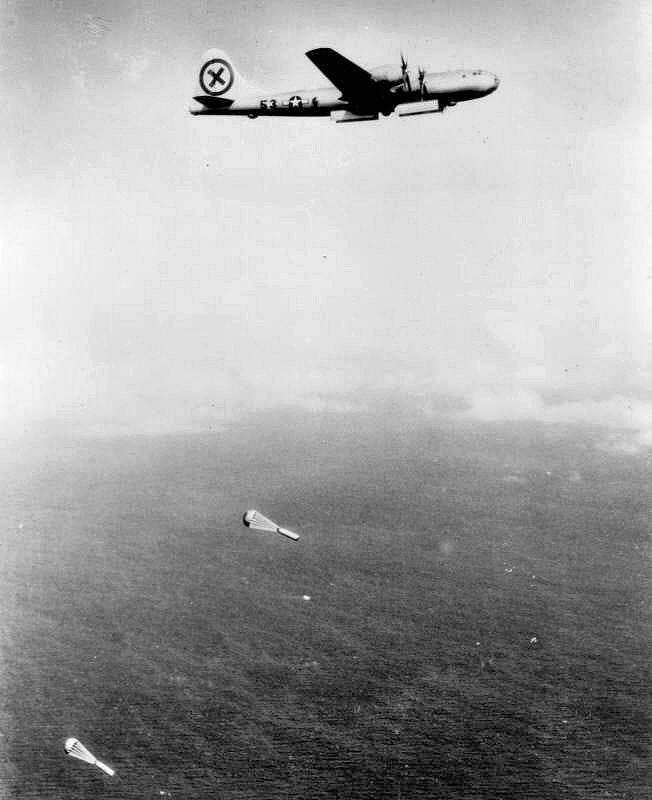
A B-29 Practicing Dropping Sea Mines During Operation Starvation, April 1945
Need I bring up the aerial bombing campaigns? Many of the big raids against cities ostensibly had military or industrial targets, but many lacked any such pretense. Just after midnight on 10 March 1945, 279 B‑29s dropped roughly 1,500 tons of incendiary bombs on Tokyo for the purpose of burning as much of the city to the ground as possible. More than 100,000 civilians died. “Operation Meetinghouse” counts even today as the most destructive aerial attack in history, even greater than the nuclear attacks on Hiroshima and Nagasaki. Aircrews reportedly had to use oxygen masks to block the smell of burning flesh.
Because these things were done prior to the 1949 Geneva Conventions, one can argue that they were neither illegal nor criminal, however deplorable. Post‑1949, however, they are. This explains why no post‑1949 conflicts have involved collective punishment. Just kidding. Civilian harm of all kinds has continued to be a regular feature of armed conflict notwithstanding the Geneva Conventions or other modern international agreements.
I am not convinced it could be otherwise, for in most cases the idea of being able to identify and exclusively target “responsible” individuals is fantastical. This might explain the rise post‑1949 of concepts such as “collateral damage,” which itself is tied to the concept of “proportionality” and the imperative enshrined in the 1949 Geneva Conventions to distinguish between civilians and combatants. The basic idea is that some civilian harm cannot be avoided. Some is acceptable. Some might even be necessary. One determining factor is intent: Does one target civilians (which implies collective punishment)? Likewise, is the military activity that harms civilians militarily necessary, which might justify the harm? Relatedly, perhaps the harm is excessive in view of the military value of what is being done. “Yes, it makes sense to do that thing, but do you have to kill so many people in the process?”
I would argue that in some cases, no civilian harm is justifiable because there is nothing legitimate about the conflict at all. Russia’s invasion of Ukraine, for example, is entirely illegitimate, for Ukraine did absolutely nothing that posed any sort of danger to Russia other than simply thriving. Every instance in which Russia does harm to Ukrainians is illegitimate and criminal. But can Ukraine harm Russians, which arguably it has by going after Russia’s economy and oil infrastructure? Presumably some Russian civilians are killed every time Ukraine pulls off one of its drone strikes deep into Russian territory. Is this “collective punishment”?
Defining the circle of responsibility and thus who might legitimately be subject to punishment becomes all the more difficult when dealing with non‑state actors. Let’s look at October 7. Hamas attacked Israeli civilians, itself arguably an act of collective punishment. Who was responsible? Hamas? Just Hamas? All of Hamas? Only those individuals directly involved in the October 7 attacks? What about Gazans who have nothing to do with Hamas? Some voted for them in 2006, just as many voted for the Nazi Party before the Nazis ended German democracy. Presumably many of those not directly involved in October 7 knew of the preparations beforehand. All those tunnels could not have been excavated without notice. All those arms and rockets could not have been amassed and assembled without many people being aware. All those hostages could not have been held and moved around without many people knowing. I am 100% certain that people at UNRWA and Médecins Sans Frontières knew what was up. Many who might not have known nonetheless cheered when they heard. How many? We don’t know. Some probably were horrified. How many? We do not know.
To some extent, the answers depend on how one perceives Hamas. Was it the government? Many argue that one cannot consider Hamas the government because one should not view Gaza as a state. Rather, Gaza remained an “open‑air prison” that was under Israeli occupation even though Israel withdrew from Gaza in 2005. I believe those who insist that Gaza remained occupied do so precisely to minimize the extent of Gazans’ responsibility for anything. As I often argue, the first law of Arab‑Israeli analysis is that Palestinians have no agency. Nothing is their fault. If Gaza is not a state, and Hamas is not a government, then Hamas is more like a rogue criminal entity that must be differentiated from Gaza and Gazans. By that definition, the circle of those who legitimately may be punished for October 7 becomes strictly limited to the individuals directly involved in the attacks’ planning and execution—but no one else. Was that ever a realistic course of action, or fantastical?
Lebanon is even trickier, for Lebanon has a legitimate and internationally recognized government of which Hezbollah is only a part. There is no mistaking the fact that many and perhaps most Lebanese dislike Hezbollah very much. Even within Hezbollah’s support base among Lebanese Shia, one can assume that not all Shia back Hezbollah. All of this greatly complicates the question: how much civilian harm is legitimate or justifiable?
I really cannot answer these questions and do not envy any military campaign planner or politician who has to decide things like how to go after Hamas or Hezbollah. As I’ve argued elsewhere, at the very least one has to take on board Admiral Raoul Castex’s concept of the “Servitudes,” which basically means that often one has to accept the need to attend to legal, moral, or political obligations rather than do whatever strict military logic might suggest. One must at least consider them and weigh them, even if only to decide to ignore them.
Where I have doubts, though, is when people insist on applying concepts such as the ban on “collective punishment” or proportionality unrealistically or unevenly. Often what one is saying is that a given country cannot fight unless it does so in a manner that effectively makes fighting impossible. That is another way of taking sides, of saying that the country should not fight because it is in the wrong.
Thus, many who argue that they support Israel’s right to defend itself but just not that way, or this way, or that other way, are lying. They do not support Israel’s right to defend itself if they would deny Israel or any other country the means to defend itself. The argument that the way a country goes about a war is illegitimate is an indirect way of saying the war itself is illegitimate. I feel that way about Russia’s campaign against Ukraine. On the other hand, those of us who might consider a war legitimate need to think hard about what precisely that legitimacy allows.
Is everything allowed?
A long time ago I visited a museum in Nuremberg that documented the rise of Nazism in the city, the climax of which was a display showing on a loop color footage of a massive antisemitic carnival that took place on the city’s main square in February 1938. The square was thronged with thousands of cheering people—a festival of hate. The next stage of the exhibit went into the bombing raids: the U.S. and Britain leveled Nuremberg. One bombing raid by the RAF on 2 January 1945 destroyed 90 percent of the city’s medieval center. It killed 1,800 and left 100,000 homeless. I could muster no remorse. In my eyes, the people of Nuremberg absolutely had it coming. Like Sodom.
I do not believe there are many Nurembergs in the world, i.e., examples of large communities of people who collectively deserve the Sodom treatment. Not even Tokyo in March 1945 was Nuremberg. There must be limits, if not for morality’s sake (morality and war are not exactly easy to reconcile), then for practical sake, which perhaps is why I refer back to Castex. Sometimes blowing everything up and killing everyone makes strategic sense. More often it does not or is simply not necessary. Perhaps, then, the test of whether something in war is legitimate or not should be the existence of realistic alternatives.
I’ll give an example: The Malian army and its Russian allies in March 2022, over the course of several days, rounded up and killed an estimated 300–500 civilians in the market town of Moura. The massacre had a military sense: JNIM, the jihadist group leading the war against Mali’s government, used markets in central Mali to generate revenue and obtain supplies. Mali’s government adopted the strategy of hitting the market towns on market days, when it knew JNIM people were present in relatively large numbers. It in fact had good intel that JNIM would be in Moura doing its thing, so it acted. The question for the Malians, however, is whether it could have achieved the same result without massacring so many people, many if not most of whom presumably were not JNIM. In fact, the Malian military almost certainly had no idea who was or was not JNIM and simply decided to kill everyone caught in its net. Could it have done better? Might it have made a good‑faith effort to identify the real JNIM people among those detained in Moura, and let the others go? Might the country have been better served, strategically speaking, if the military had acted differently? I’m inclined to think yes, the Malians could have and should have done better. It was in their interest to do better.
It takes two
Malians I’ve spoken to often argue the criticism of their army’s conduct at Moura is unfair because the people they are fighting, JNIM, do not play by any rules. These are jihadists terrorists. They complained that Human Rights Watch, which wrote an important report on the massacre, was on JNIM’s side. They said the same thing about the UN, whose investigation of the massacre was one of the reasons why Mali ended up kicking the UN peacekeeping mission out of the country. I get it, even if I believe they are wrong. I have seen no evidence of any anti-Mali animus among UN or HRW personnel. No one questions Mali’s existence or wishes it would fall. In contrast, I am convinced that the HRW and the UN have taken Hamas’s side in the Gaza war and essentially believe Israel had it coming on October 7. Certainly in the UN’s case, the evidence of an animus against Israel is undeniable.
Setting my suspicions aside, there is a pattern in which one side is allowed to conduct collective punishment, while the side opposed to it is condemned for it. One wrong does not justify another, but there is a case to be made for parity at least with respect to collective responsibility. Is everyone guilty or just some? Are Israeli civilians more or less responsible for the alleged crimes of their governments than Gazans? Or vice versa? Maybe. Israel is a democracy. Gaza is not. Putin’s Russia is not. Nazi Germany and Imperial Japan were not. But does that mean every Israeli is fair game? Or every other member of every other democracy? Or just some. Who? Likewise, I am uncomfortable with anyone who assumes either that all Gazans are innocent, or all are guilty. It’s not that simple. Nothing every is.
Perhaps the bottom line here is that however much we would like things to be black and white, especially in matters such as war crimes or atrocities, they seldom are.
If you like this content, please consider a paid subscription to support my work, or you can Buy Me a Coffee. Also check out my recently published book, “The French Way of War,” available internationally on Amazon in English and in French.