
Operation Just Because

All the evidence suggested that Trump was going to attack Venezuela. But, when asked, I hesitated. Despite all the signs pointing to an attack, part of me refused to believe he would do it. Why? Because I saw no reason for it. Because it was crazy. In retrospect, I was naive: The fact that it was crazy was part of why Trump could not resist the temptation.
So now what? What should we think about what Trump did? Is this good or bad?
There are two responses I’ve seen that should be rejected out of hand. The first is any attempt to rally behind Maduro and insist on his reinstatement. Let’s be clear about this: Maduro is a bad guy, and everyone is better off without him. The second is the jingoistic “America Fuck Yeah!” response.
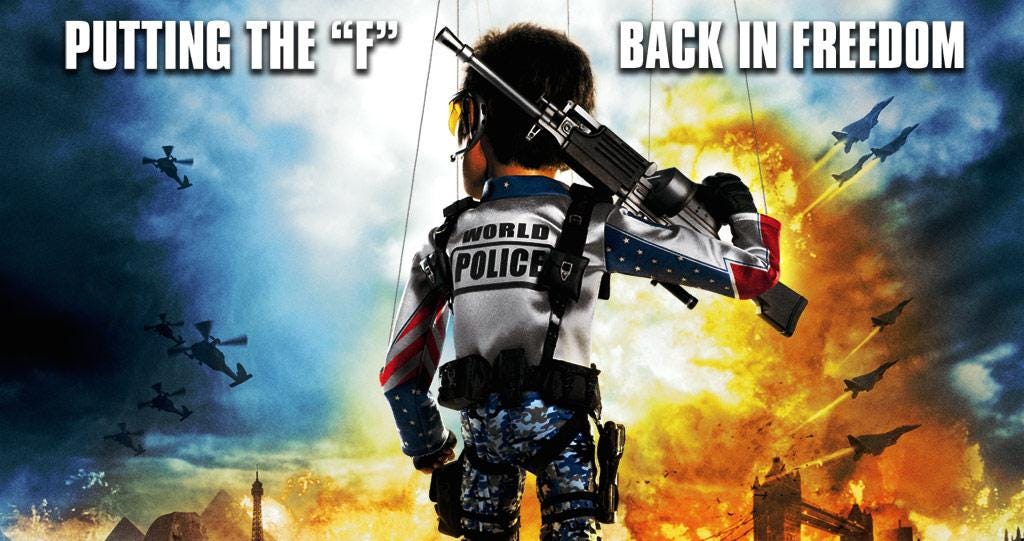
Team America. An underrated classic.
I confess to feeling a bit of thrill at the display of American military muscle. What the military did was astonishing. It was a performance of prowess and virtuosity that no military can rival. No one can do what the U.S. military just did. Remember Russia’s little 3-day special operation in 2022 that’s still going on?
I was reminded of when Desert Shield turned into Desert Storm in 1991. I was living in France and watched it all through the French media. The reaction on the part of the French press and French commentators boiled down to “Holy Shit!” Such was the enormity of the military machine the U.S. deployed. It put everyone else in their place.
We have to push past the enthusiasm and think. What has Trump done? What is he doing? What will be the consequences?
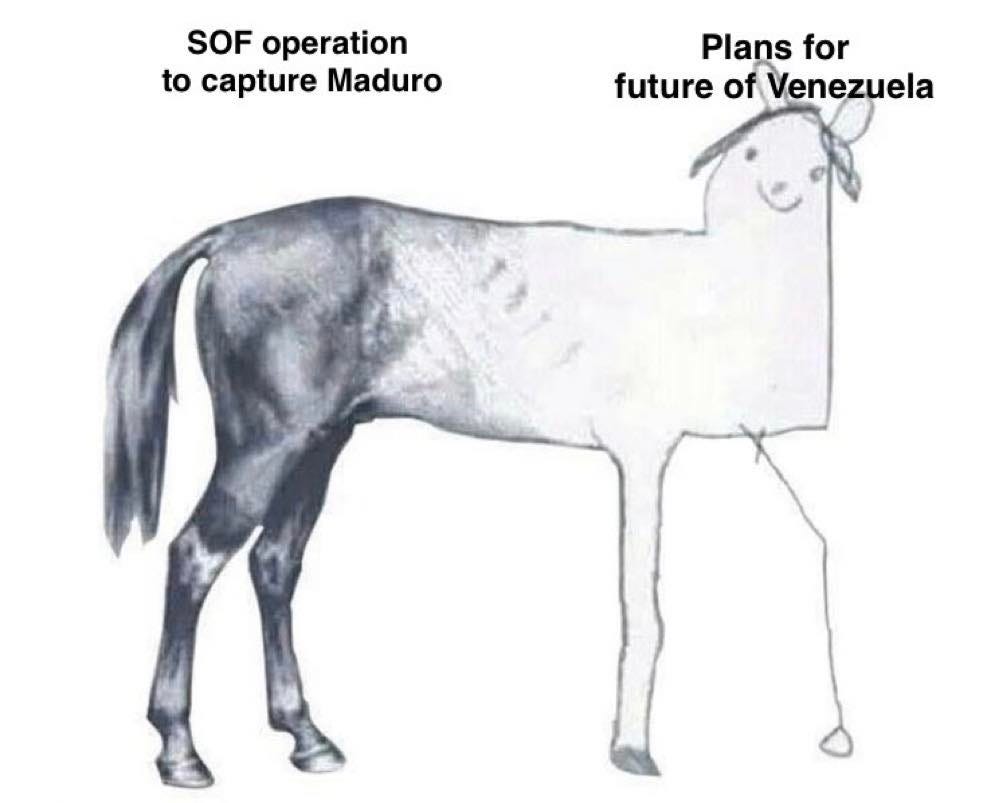
A few weeks ago I posted a video about Venezuela and military strategy. The concern I voiced then was about planning and strategy. Was there a plan? Was there a strategy? I voiced optimism that an invasion and regime change could be done successfully provided the U.S. Government planned carefully and lined up many, many ducks. Like, reaching out to members of the Venezuelan military. Reaching out to the opposition. Perhaps orchestrating moves with the Venezuelan opposition leader and newly minted Nobel laureate María Corina Machado Parisca, whom one might have assumed Trump would want to install on the throne after deposing Maduro. Making sure that lots of people knew what to do and when, to guarantee a smooth transition with minimal violence. But I also voiced skepticism that the crew currently in charge of the U.S. Government was capable of such careful planning.
At the minimum, one needed a clear idea of the desired political outcome. What precisely does one hope to achieve by invading and doing whatever one’s going to do? Establish what? Put who in charge? To what end, etc? Afterall, the easy part was invading and blowing up or killing anything and anyone we wanted. The US military is unsurpassed in its ability to blow stuff up. The hard part is everything that comes after. Might there be a strategy?
What I see is not encouraging.
Trump, rather than enthroning Machado, has put her down. He said about her:
I think it would be very tough for her to be the leader. She doesn’t have the support within or the respect within the country. She’s a very nice woman, but she doesn’t have the respect.
Ok, so we’re not putting Machado in power. Instead, Trump has let Maduro’s Vice President, Delcey Rodriguez, assume control. She naturally has voiced her support for Maduro and said she would not cave to Trump, but it is easy to imagine why she might prove pliant in the face of whatever demands Trump might make. She’s probably terrified. She should be. However, this also means that there will be no regime change. We’ve just replaced the guy at the top with his deputy.
At the same time, Trump has suggested that the US would run things, though he and his Administration have given no coherent explanation of what that might mean. He also has suggested that the US would play a major role in managing Venezuela’s oil industry. What does that mean?
Speaking of an occupation, Trump said it would be fine because it would pay for itself. That’s precisely what the Bush admin said about Iraq. Also, even if it turned out to be true, is that what the war is about? Booty?
What about international law and norms?
Many of the people responding to the attack, especially those opposed, have brought up international law and norms, i.e. the notion that sovereign nations should not attack other sovereign nations except in self-defense or with a United Nations sanction.
I’m not a huge fan of the international law arguments. The way people reference international law makes it sound more like a religious fetish than anything real. Like an idol, a piece of stone one imagines is inhabited by a powerful divinity. Most of the time I hear “international law” brought up, it is as a weapon intended to deny Israelis the right to defend themselves. “Israel gave someone a stern look in violation of international law and must be brought before the International Court of Justice.” Moreover, I think the so-called post-war liberal international order was always nothing more than something the U.S. created out of a sense of decency and nobility, but most of all because it served American interests. So when people today clutch at their pearls and deplore the return of the law of the jungle, one has to wonder where such people have been these past 80 years. It’s always been the law of the jungle, only we’ve been pretending otherwise.
In contrast, I take the U.S. Constitution seriously. America is not the world, it is a liberal Constitutional republic wherein the law is everything. As it happens, Trump didn’t ask Congress for permission. He didn’t notify anyone in Congress either. He just did it.
Is this acceptable? For the past 40 years or more, we’ve more or less been operating this way. President George H.W. Bush did not ask for authorization to invade Panama and abduct President Manuel Noriega. Bush did notify some members of Congress a few hours before, but that was it. Afterward, because the whole thing was over quickly and was successful, Congress retroactively supported the move. Politically, that’s understandable. Was it really the best thing for Congress to have done? And now, in 2026, Congress do anything whatsoever to check the authority of the executive? This is a debate we absolutely must have regardless of how we feel about Maduro.
Now, to get back to international law, there is something to the argument about norms. About normalizing the idea that sovereign nations can attack one another. We are perhaps better off agreeing to believe that that’s a bad idea, and that countries shouldn’t attack one another without cause. Because, I hate to say it, the Trump Administration has not established to my satisfaction that it had “just Cause” in going to war against Venezuela. Remember Operation Just Cause, our invasion of Panama in 1989-1990? Even then I thought it was b.s. But now? The case for war is radically weaker than it was in 1989. The correct name for what we did in Venezuela should be “Operation Just Because.”
Was this all about oil?
I’m not convinced. The prospect of getting control over Venezuela’s oil might help make the whole thing more attractive for Trump. On the other hand, it is no longer the case that the United States needs oil. Oil, moreover, is an internationally traded commodity. There is a global supply that comes from many sources. Whether or not we import from Venezuela is neither here nor there. Moreover, from what I’ve read, Venezuela’s oil industry is in bad shape and needs massive investments. Grabbing its oilfields is not like walking out of the Louvre with some crown jewels, instantly rich.
What then?
What we’re seeing is a mutation and perhaps vulgarization of the neo-conservatives’ contempt for the liberal order and the orthodoxies related to statecraft that have dominated American thinking since WW2. It’s less about oil than it is about flaunting that contempt and rejecting the liberalism that has defined the Pax Americana until now. We no longer care about diplomatic niceties or norms or even pretending to be mindful of international law. We no longer are impressed by the friendship of countries like Denmark. We want a post-liberal or perhaps a pre-liberal sort of Empire in which we take what we want, and flex our power because we can. We want to do it for the sake of owning the Libs, and enraging people like yours truly. So this is the misbegotten child of neo-conservative theory and yahoo anti-intellectualism.
The true neo-cons were intellectual elites armed with Ivy League pedigrees and high brow arguments. These were people who read Leo Strauss and thought him meaningful. I am thinking of people like Francis Fukuyama, or even Donald. Rumsfled, who, it must be acknowledged, was a highly intelligent and capable man. Today? Trumpist conservatism is less the Yale-honed pretentiousness of William F. Buckley and more about sigma males strutting their stuff on TikTok. This is about Hegseth’s preening Warrior self-image, and RFK doing pull ups while scoffing at science and scientists. Bunch of pencil necked geeks.
It’s as if Americans today are too stupid for neo-conservatism and have traded it for internet brainrot.
Let’s recall that the whole critique of despotism is that the despot can do whatever he wants according to his whim. He could, in theory, be an enlightened despot. That’s great, because an enlightened despot would be super efficient. But: He could be a psychopath. Or an imbecile. Or crazy. Or just corrupt. So let’s say we agree with what Trump just did. But if he establishes that the US president can do whatever he wants because he can, what if the next president is wrong? The Constitution and all that checks and balances stuff was intended to preserve us from being ruled by a mercurial despot, even if that means having to put up with an inefficient government that often feels incapable of getting anything done. The Founding Fathers saw that very inefficiency as the price of liberty. Likewise, the liberal order is supposed discourage countries, especially the more powerful ones, from acting with impunity the way Russia is doing with Ukraine. Liberal norms and international law obviously did not stop Putin from attacking Russia, but I can’t help but feel that by at least sometimes caring about such things we ensure that we’re not quite as bad as Putin’s Russia. We might check our own use of our own power and think twice. Or am i just fooling myself?
Conclusion: Venezuela, good or bad?
The best I can offer as an answer is this: We should be pleased to see Maduro’s backside, but all of us, Americans included, should be worried about the ability of one man to take out another world leader because he felt like it. An American president’s unlimited ability to do that does not give me comfort, even if I agree that the target this time was valid.
I’m fine with capturing Maduro, but this whole “we’re going to run Venezuela” thing is bizarre. It’s even worse than “we’re going to turn Gaza into the next Riviera.”
Seva Gunitzky has written about how this legitimizes Spheres of Influence thinking to the benefit of China/Russia and I agree. So yes, international law is on life support and often misused, but it probably was still helpful in preventing a full return to the law of the Jungle.