
Tuareg Deep Dive

As a follow up to the video I made last week, here’s a deep dive about Mali’s Tuaregs. More soon. And if I weren’t busy enough, it looks like the Iran war’s about to heat up again.
Here’s the script I sort of followed.
Tuareg Deep Dive – Revised Script
Hi. Last week I published a 45‑minute explainer video about Mali’s conflicts and joked that I could easily make a 10‑hour video, but none of you would want to watch that. Judging from the comments, I may have been wrong: some of you probably would watch 10 hours of me explaining Mali. But I’m not going to do that. Instead, I’m going to make smaller videos on specific topics.
In this one, I want to do a deep dive into Mali’s Tuareg community. Mali’s Tuaregs play a disproportionately large role in the country’s internal conflicts, and if you read any news article about Mali you’re likely to encounter the word “Tuareg.” My aim here is to go deep into Mali’s Tuareg community and share what I know so you can better understand both the news and the current war.
If you’re new here, my name is Michael Shurkin. Welcome to my channel, Pax Americana, a conversation about world affairs, global conflict, military strategy, and anything else that happens to be on my mind. As usual, if you like this content…
Let’s get cracking. We have a lot of ground to cover. I’m going to divide this video into several parts. I’ve put timestamps in the description so you can skip around if you want.
Part 1: Sources – what I’m drawing on and where you can read more.
Part 2: Tuareg 101 – who the Tuaregs are, where they live, and how they live.
Part 3: Northern Mali and Tuareg social hierarchy – who lives there, and how Malian Tuaregs are organized socially and politically.
Part 4: Tuareg political history to independence – roughly from the 1890s to 1960.
Part 5: Post‑independence Tuareg rebellions in Mali.
Part 6: Malian Tuaregs today – between JNIM and the FLA.
Are we ready? Let’s go.
Part 1 – Sources
I want to start with the sources for this video, for two reasons. First, to show that I am not pulling this from Wikipedia but from serious academic work and primary sources. Second, to point you toward good reading if you want to go deeper.
The core academic works that shaped my understanding of Tuaregs in general, and Malian Tuaregs in particular, include:
Pierre Boilley
Baz Lecocq
Charles Grémont
Georg Klute
Then there is one of my all‑time favorite books about Mali: Amadou Mariko’s Mémoires d’un crocodile. It offers invaluable insight into north–south relations, how northerners and southerners perceived each other, what happened when the Malian army arrived in Kidal in the 1960s, and how the 1990s war played out on the ground.
These works, plus a broader literature and various reports, are what I’m drawing on here.
Part 2 – Tuareg 101: Who are the Tuaregs?
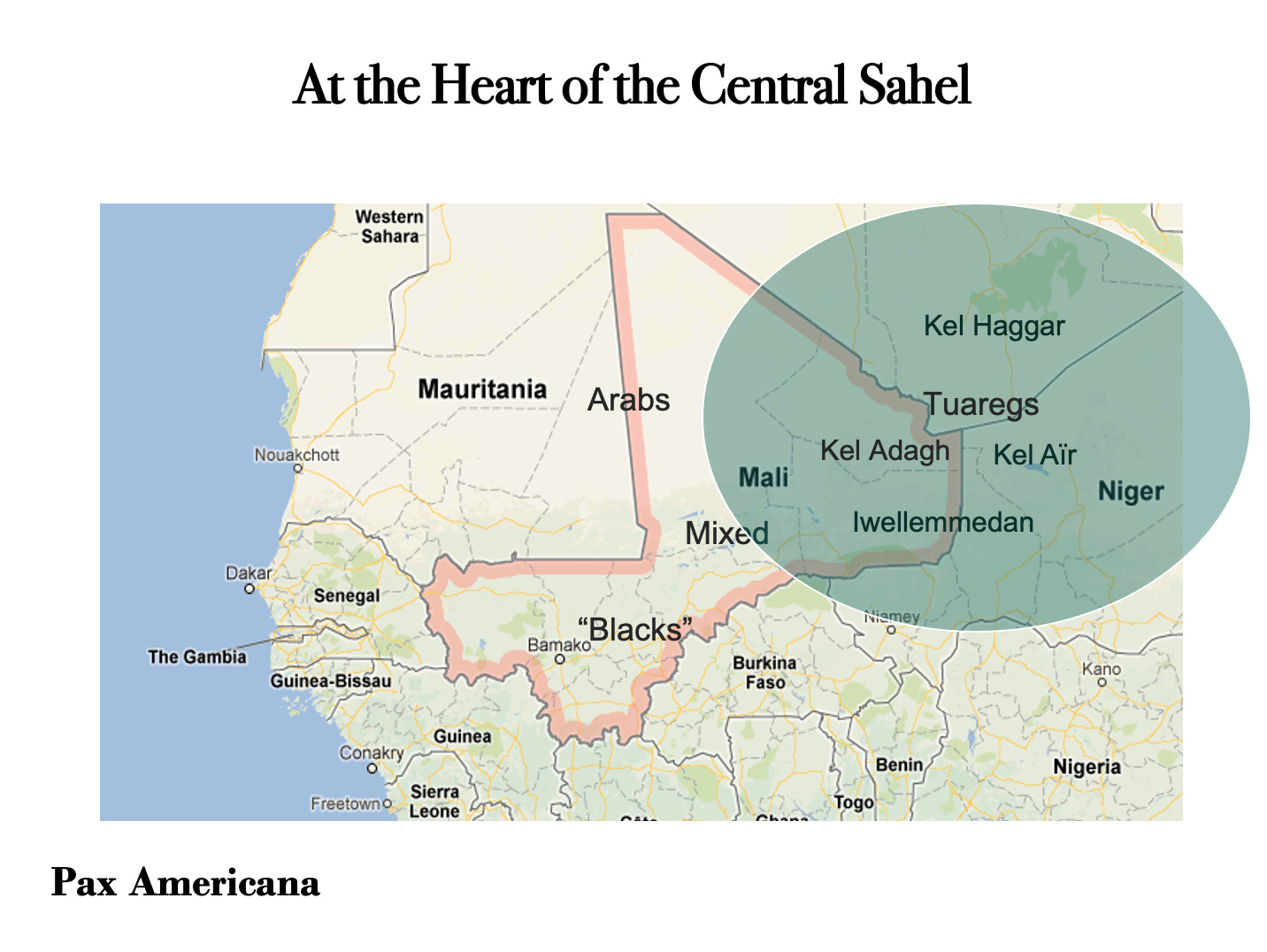
Tuaregs are a subset of Berbers. They speak a Berber language known as Tamashek and inhabit the central Sahel and Sahara, across several countries, including Mali.
Historically, they survived through several main activities:
Transhumant nomadism: moving herds from one area to another, based on intimate knowledge of where and when there will be enough vegetation, depending on rainfall and even dew.
Trade: until not that long ago there were large camel caravans traversing the region east–west and north–south. They carried salt, ivory, gold, ostrich eggs, slaves—yes, slaves—and anything of high value that could be transported easily.
That trade still exists, but today it is mostly done by truck. The cargo now includes everything from cooking oil to small arms. Human trafficking is still a thing, but more in the form of migrants trying to reach the Mediterranean and Europe. Counterfeit cigarettes are a major commodity. So are narcotics coming from South America via Africa’s Atlantic coast on their way to Europe. There is a lot of drug money flowing through northern Mali.
Tourism used to be important for some Tuareg communities: desert music and cultural festivals, guiding tourists, even events like the Paris–Dakar rally. Jihadist terrorism has essentially wiped out that industry. Many Tuaregs have suffered from jihadist terrorism, not just from state violence.
There are also Tuareg farmers, and many urban Tuaregs. In Bamako you find significant numbers of Tuaregs who are politicians, administrators, soldiers, teachers, and civil servants. We tend to associate Tuaregs with nomadism in our minds, but they are much more than that.
Confederations
In the 19th century there were three major Tuareg confederations in the central Sahel:
The Kel Ahaggar (Kel Haggar) in what is now southern Algeria.
The Kel Aïr in what is now Niger.
The Iwellemmedan in what is now Mali and Niger.
When the French arrived in southern Algeria, northern Mali, and Niger, they had to deal with these confederations one way or another. The first French column that tried to seize Timbuktu in 1893 was wiped out by Tuareg forces. France sent a second expedition under Joffre later that year. This time they were more careful and took their time to study the “human terrain.”
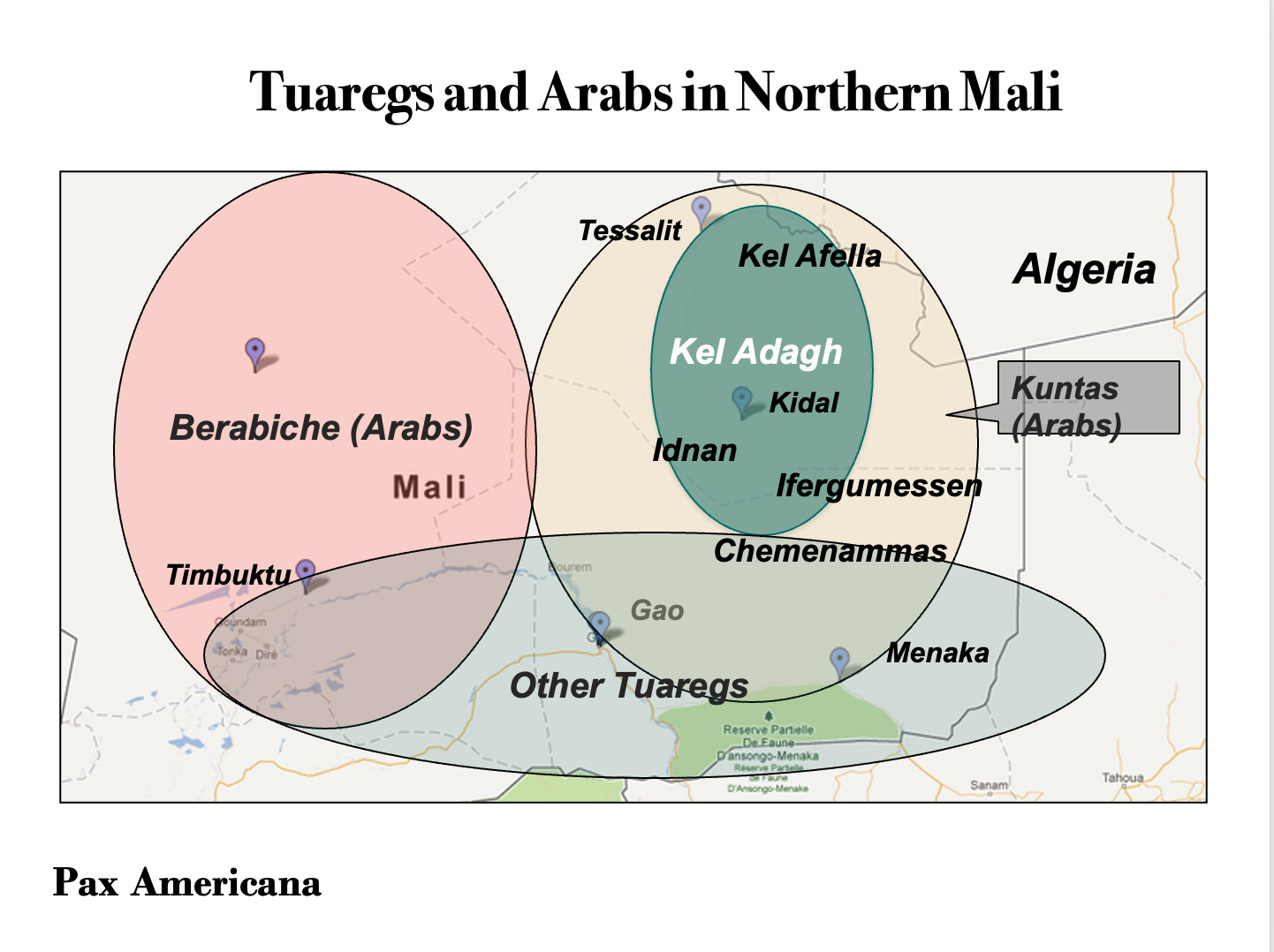
They concluded that the most powerful confederation in what is now Mali was the Iwellemmedan. They also realized that the way to contain them was to ally with two groups that paid tribute to the Iwellemmedan:
The Kounta Arabs.
The Kel Adagh Tuaregs.
The Kel Adagh were a separate confederation but subordinate to the Iwellemmedan, paying them tribute.
This arrangement worked in France’s favor until 1916, when the Iwellemmedan rebelled against French rule. France, leaning on the Kel Adagh and Kounta, crushed the rebellion and broke Iwellemmedan supremacy. As a result, the Kel Adagh emerged as France’s favored partner and ended up at the very top of northern Mali’s socio‑political hierarchy—despite being relatively few in number.
How many Tuaregs are there?
Nobody really knows. How many Tuaregs in total? No one knows. How many Tuaregs in Mali? Also unclear.
We have some credible data about language use but not about ethnic self‑identification. Language is a rough proxy for ethnicity: Tuaregs generally speak Tamashek, but all Tuaregs are multilingual, and different people will give different answers when asked what their “primary” language is. The best evidence suggests that the number of Tamashek speakers is larger than the number of people who would identify as Tuareg.
In my last video, I said that roughly ten percent of Malians—about 2.2 million people—live in northern Mali. As far as we can tell, most northerners are not Tuareg. Tuaregs are a majority in Kidal and a few smaller towns, but not in Gao or Timbuktu. There, the majority appears to be Songhai, and the lingua franca in those towns is Songhai, not Tamashek. There are also Tuaregs in Bamako and elsewhere in southern Mali. But we do not have reliable numbers.
The best available evidence suggests:
Tuaregs make up a single‑digit percentage of Mali’s total population—probably well under 5%.
Even in the north, Tuaregs likely make up under half the population.
Keep that in mind when people casually equate “north” with “Tuareg.”
Part 3 – Northern Mali and Tuareg social hierarchy
Now let’s get into Tuareg politics and social structure.
Tuaregs historically have been organized into tribes or clans, which themselves are structured into castes and then grouped into larger tribal confederations.
Within this world:
Some tribes are noble tribes.
Some are commoner tribes, often described as vassals.
There are artisan or blacksmith groups.
On the margins are groups descended from slaves.
Among the nobles, some derive status from being warrior aristocrats. Others derive it from religious authority, often claiming descent from the Prophet Muhammad or from Arabs who took part in the conquest of the Maghreb. Tuareg society is hierarchical and stratified, even if all of that is evolving under modern pressures.
Shameless Book Plug
Part 4 – Kel Adagh hierarchy and internal competition
In my previous video, I argued that the French effectively froze a socio‑political hierarchy in place. After they left, that hierarchy began to unravel as different groups challenged their position. Higher‑ranking groups tried to defend their prerogatives. Lower‑ranking groups strove to raise themselves.
Tuaregs in Mali were not an exception. They were by and large at the top of the northern social order, in part thanks to the French. At the same time, the southern‑dominated government in Bamako did not like or trust them. So Tuareg elites wanted to defend their status not only vis‑à‑vis the new state but also vis‑à‑vis other northern groups that were trying to climb the ladder. And this competition also played out inside the Tuareg community.
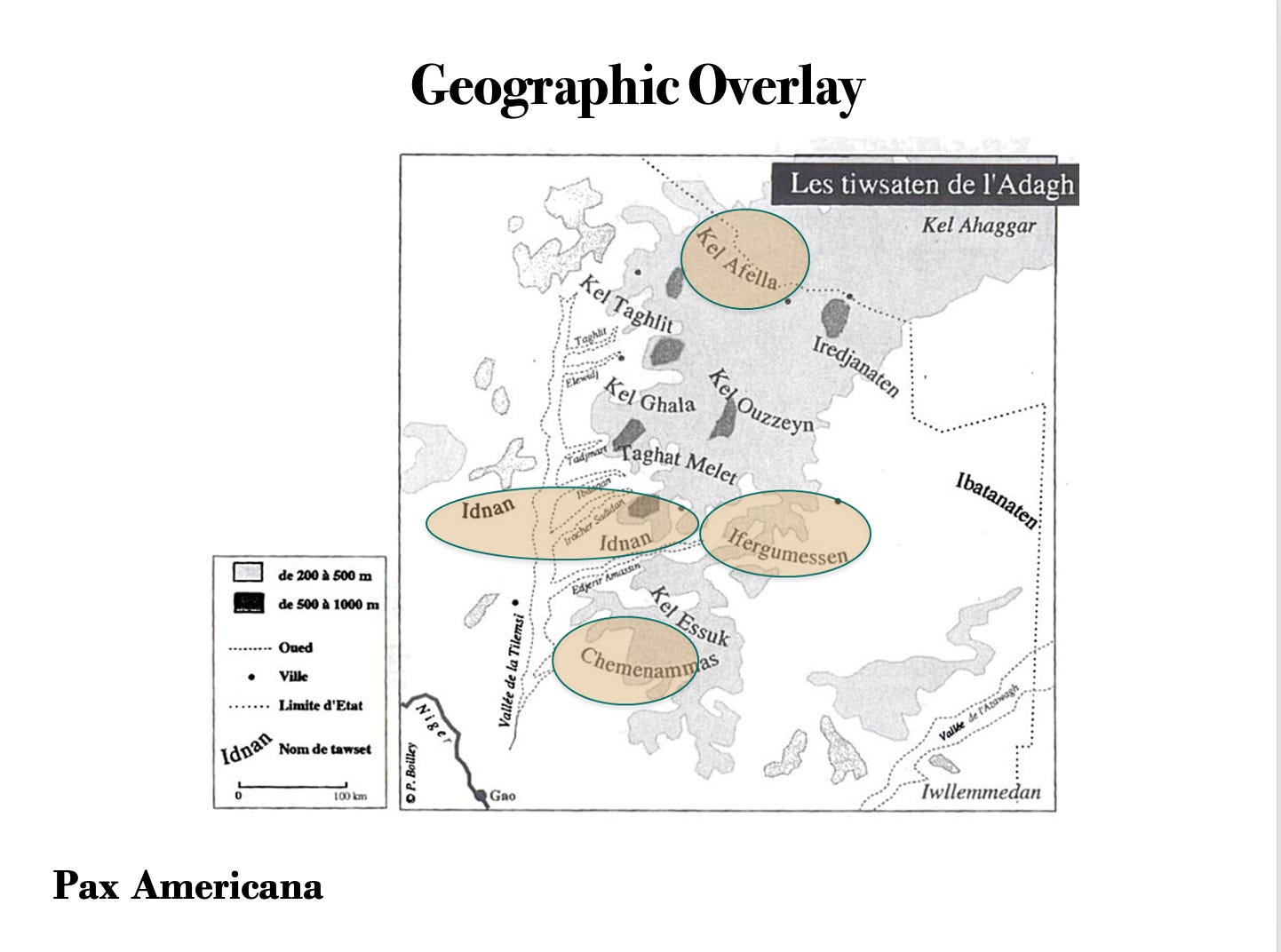
Let’s focus on the Kel Adagh. The Kel Adagh confederation consists of perhaps two dozen sub‑groups arranged in lateral and vertical hierarchies. Where a tribe sits in that matrix—how far it is from the “top left corner”—matters enormously.
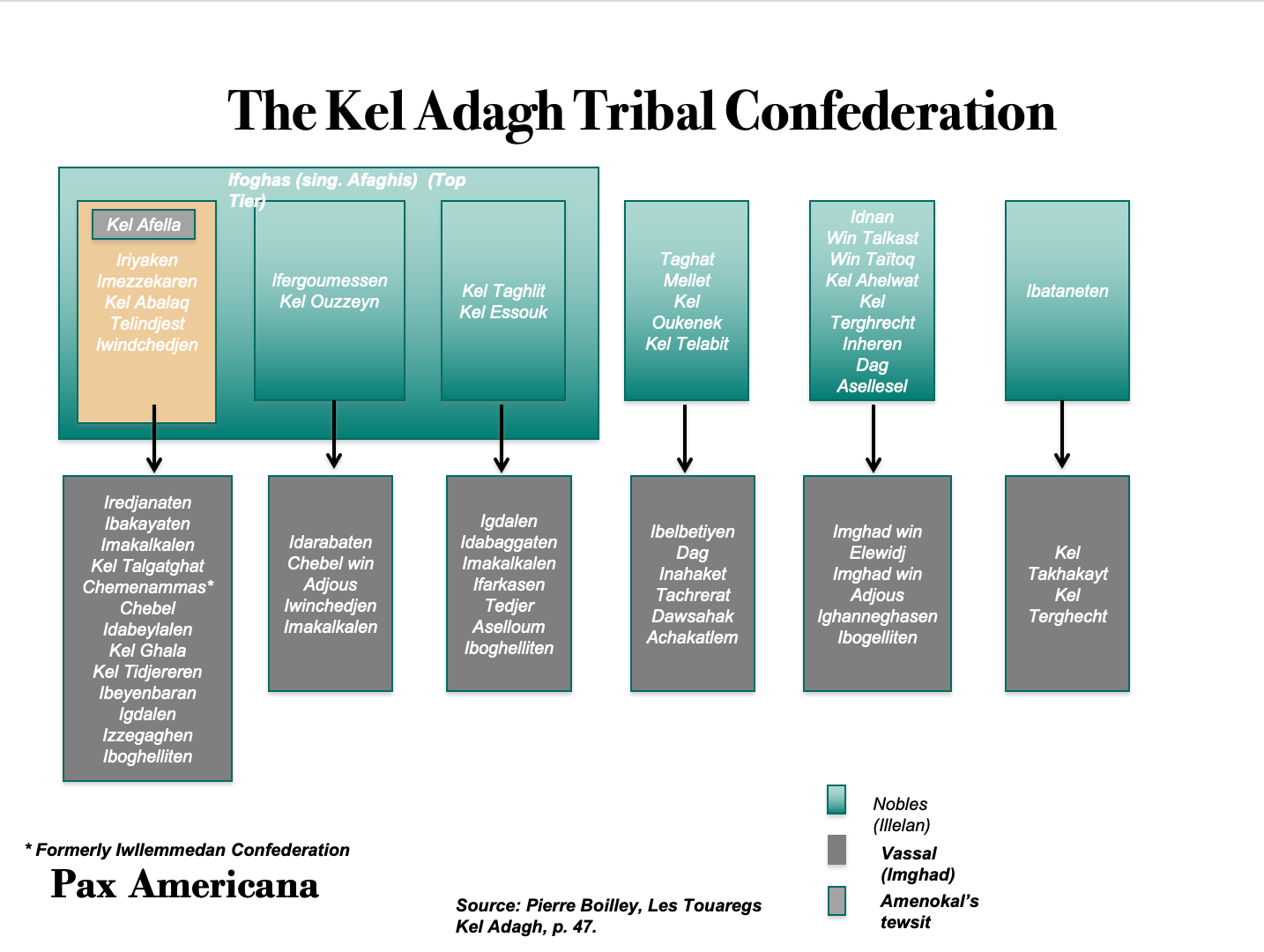
Here I’m drawing on a chart from Pierre Boilley’s work, which maps Kel Adagh tribes into noble and vassal categories. I’ve reproduced his schema in my slides; the data are his.
In blue‑green: noble tribes.
In gray: vassal or commoner tribes.
The top‑tier aristocrats, the crème de la crème, are the Ifoghas. The commoners are generally referred to as Imghad. At the very top, in the far upper left, is the tribe of the traditional leader of the entire confederation. His title is Amenokal. His tribe is the Kel Afella.
The current Amenokal of the Kel Adagh is Mohamed ag Intalla, descendant of the Amenokal who made the security alliance with France in 1916.
The Amenokal does not exercise centralized command over the whole confederation, but he does enjoy real moral authority and prestige. People don’t automatically follow his lead, but his position matters. Within the confederation, as in all of northern Mali, groups have been jostling for power since independence. Higher‑ranking tribes defend themselves against ambitious lower‑ranking ones while also jealously eyeing those above them.
Some of the most “troublesome” actors have been people from elite tribes who resent playing second fiddle to even more elite families. Iyad ag Ghali, the current emir of JNIM, is from the Iriyaken, arguably the number‑two tribe in this hierarchy. One theory about his turn to jihadism is that he sought to eclipse the Amenokal’s authority by being, in effect, more Catholic than the pope—using religious radicalism to outflank traditional authority.
The MNLA, which is a direct predecessor of today’s FLA, was likewise dominated by second‑ or third‑rank Kel Adagh nobles—still elite, but not the top of the pyramid.
This complicates how we think about rebellion and political objectives. Take Iyad in the 1990s:
He led the MPA, a militia that defended Kel Adagh, and especially Ifoghas, primacy.
Sometimes he fought for Tuaregs against the Malian state.
Sometimes he fought for Ifoghas supremacy against other Tuareg factions.
On the other side, General El Hadj ag Gamou led a commoner militia that wanted to overturn the “feudal” system and end Ifoghas dominance. That helps explain why he ended up firmly pro‑state while the Ifoghas often aligned with insurgents. Gamou, importantly, is Iwellemmedan rather than Kel Adagh, which arguably makes him a double threat to Kel Adagh nobles.
Part 5 – FLA, representation, and Tuareg rebellions
Fast‑forward to today. The FLA is predominantly Tuareg, and among its Tuareg members, I’m quite confident that Kel Adagh—especially elite Kel Adagh—are over‑represented. This was already the case with the MNLA.
The reported leader of the FLA is our old friend Alghabass ag Intalla, from the Ifoghas nobility. Its number two is Bilal ag Acherif, who is generally identified as an Idnan Tuareg, which is an elite Kel Adagh tribe. Bilal and Alghabass are both Kel Adagh, but from rival fractions.
Sometimes they act as if those divisions don’t matter. Sometimes they act in the collective interest of all Kel Adagh. Sometimes they act in the interest of their particular fraction, against each other and against other Tuareg and non‑Tuareg groups.
So how representative is the FLA of northerners in general? Not very.
How representative is it of Mali’s broader Tuareg community? Also not very.
We don’t even know how representative it is of the Kel Adagh themselves. And we don’t know what percentage of Malian Tuaregs are Kel Adagh.
A quick detour: elections and local power
One way to get a sense—however distorted—of who is numerically strong is to look at elections. Mali did have elections, especially after the democratic transition in 1991. What happened then was that local elites worked very hard to hijack the electoral process and ensure that the results confirmed rather than challenged their primacy, regardless of actual numbers.
In Kidal, the Amenokal’s people were challenged by others, but they fought back. The civil war of the 1990s was, in many ways, a success for the Ifoghas, who—with crucial help from Iyad ag Ghali—were able to fend off threats to their primacy and cement a strategic alliance with the Malian state. This time, instead of the French, their main partner was the Malian government.
That arrangement held until around 2007, when Bamako shifted its support toward Gamou’s commoner militia, which became known as GATIA. That realignment set the stage for the next round of conflicts.
I think I’ll need a separate video to talk about how democracy did or did not work in Mali, and what happened after the democratization wave that began in 1991.
Part 6 – Post‑independence Tuareg rebellions
I count four major Tuareg rebellions in Mali, plus the current phase, which I see as a continuation of 2012:
1963–1964
1990/1991–1996
2006–2009
2012
And the current round, which I see as “phase two” of 2012, triggered largely by the Malian state’s choices.
The 1963–64 rebellion
The first rebellion in the 1960s was led by, and almost entirely composed of, Kel Adagh Tuaregs. It is also the only one the state decisively defeated. Mali did so brutally—poisoning wells, carrying out summary executions, and terrorizing communities.
Amadou Mariko’s memoir is one of our best testimonies for this period. He describes how southern Bambara‑speaking soldiers and northern Tuaregs might as well have come from different planets. They had difficulty even communicating. Gestures meant to signal respect in Tuareg culture were read as disrespect in southern culture, and vice versa.
There were also issues of sexual violence and profound misunderstanding. Tuareg women had a reputation—at least in southern imagination—for relative freedom in choosing partners. Some soldiers took that to mean they could help themselves. You can imagine how that played out, especially when women became pregnant. All of this was accompanied by violence against Tuareg civilians.
The state “won” militarily, and there was a kind of peace, but at a terrible cost.
Droughts and radicalization
The 1980s brought severe droughts and extreme suffering in the north. Many Tuaregs left for Libya and elsewhere in search of work. Some were drawn into Gaddafi’s projects and ended up in his “Islamic Legion” in Chad and Lebanon. Others languished in refugee or aid camps.
Many of those who returned came back angry and politicized. But they did not all agree on what the “revolution” should be about:
For some, rebellion against the Malian state.
For others, rebellion against the status quo in the north, which meant against both the Malian state and the Kel Adagh hierarchy.
The 1990s rebellion
The second rebellion, starting around 1990–1991, began as a rebellion against the state but turned into a general melee among northern armed groups.
Kel Adagh factions helped start it.
Other Tuareg groups joined in, some for the state, some against it.
There were Arab factions on both sides.
Songhai militias generally supported the state.
The Tuareg faction that emerged strongest was Iyad ag Ghali’s MPA, which fought as much to defend Ifoghas prerogatives as to assert northern autonomy.
The 2006–2009 rebellion
The 2006–2009 rebellion was also largely driven by Kel Adagh factions, with some others joining. Iyad ag Ghali tried to co‑opt and contain this new wave, with mixed results.
The 2012 rebellion
The 2012 rebellion, again with a disproportionate Kel Adagh footprint, initially went well for the MNLA and its allies—until their jihadist partners, including factions with strong Kel Adagh involvement, displaced them. The jihadists hijacked the rebellion and took over much of northern Mali.
Peace accords that ended the 1990s conflict, the 2006–2009 episode, and the 2012 rebellion followed a familiar script:
The Malian state promised decentralization, more local autonomy, and development.
The Malian military would withdraw or tread lightly in the north.
Tuareg and other northern militants would disarm, go through DDR, and either demobilize or integrate into Malian security forces.
International NGOs and the UN rushed in to support all this.
None of these agreements really lasted.
Why?
Bad faith on both sides.
The fact that many rebellions were less about autonomy from Bamako and more about local power struggles among northern groups and within Tuareg society.
Those power struggles were zero‑sum, with clear winners and losers.
For many actors, taking up arms was the most effective way to advance one’s group interests—and profitable. There was much less profit in peace and in going back to transhumance.
Why the state can’t repeat 1963–64
Why hasn’t the Malian state crushed northern rebellions again the way it did in 1963–64?
Relative weakness: the state’s logistical reach and combat power in the north are limited.
Environment: the terrain, climate, and distances all favor small, mobile insurgent groups over regular forces.
Cultural and linguistic gaps: southern troops often have limited understanding of local society and language.
The result is a very uneven playing field in which a relatively small number of highly mobile rebels can run circles around a regular army with weak logistics and little mobility.
Part 7 – Tuaregs and jihadism
Traditionally, Tuareg Islam is described as distinct from hard‑line Wahhabi or Salafi currents associated with al‑Qaeda or the Islamic State. It is often characterized as Sufi‑inflected and relatively tolerant.
I recall spending a long afternoon on the outskirts of Bamako with a Kel Antsar Tuareg holy man who told me, “How can I hate anyone? God made us all, so how can I hate something God made?”
In the late 1990s, some Tuaregs were exposed to new Islamist ideas brought to northern Mali by the Tablighi Jamaat (often referred to locally as “Tabligh” or “Da‘wa”). How many people were seriously influenced? We do not know, but it does not appear to have been a mass phenomenon.
What we do see, which is common in many Muslim societies, is this dynamic:
Traditional Islamic authorities are closely tied to the local political establishment.
One way to rebel against the political order is to oppose those traditional religious authorities in the name of a “purer” Islam.
So rejecting traditional religious leaders becomes a way of rejecting the political establishment.
When Algeria’s GSPC (which later became AQIM) moved into northern Mali, there was substantial evidence of cooperation between them and local Tuaregs. Why?
The best answer many of us came up with at the time is that this had much more to do with business than with ideology. If you’re living in that environment and a group shows up with cash and wants to buy diesel or hire guides, are you really going to say no? It was transactional.
Around this time, Iyad ag Ghali became increasingly involved with the GSPC and, while serving as Mali’s ambassador to Saudi Arabia, reportedly became more personally Islamist. At the time, I argued that even if he might be sincere, he was also instrumentalizing religion to advance his own political project—in part his rivalry with the Amenokal’s clan. Again: being “more Catholic than the pope.”
Some Tuaregs were attracted to AQIM’s message and opportunities, especially as GSPC morphed into AQIM. In late 2011, Iyad formed the Islamist group Ansar Dine, which was predominantly Tuareg and predominantly Kel Adagh. At the top with him was Alghabass ag Intalla, brother of Mohamed ag Intalla, the current Amenokal.
When France intervened in January 2013, Alghabass quickly repositioned himself, forming new organizations designed to protect Ifoghas interests without attracting French airstrikes. Iyad, by contrast, stayed with Ansar Dine and cemented his alliance with AQIM.
In 2017, Ansar Dine and AQIM components merged into JNIM, with Iyad as its leader. At that point, whatever his inner motivations, he is functionally a committed jihadist leader. If he walks like a jihadist, fights like a jihadist, and talks like a jihadist, we have to treat him as a jihadist, regardless of what is in his heart of hearts.
Where Tuaregs stand today
Today, we clearly have:
Tuareg jihadists in the ranks of JNIM.
Tuareg rebels in the ranks of the FLA.
Tuaregs in the Malian military—many of them Imghad and other commoner groups, and relatively few from Kel Adagh noble families.
Which of these is most representative of Tuaregs as a whole? Of northerners as a whole?
I strongly doubt that most northerners are in league with JNIM or the FLA. I also doubt that most Tuaregs are. The best available evidence suggests:
Jihadist Tuaregs are a small minority of the overall Malian Tuareg community.
Tuareg rebels who have rallied behind the FLA are also a minority of the overall Malian Tuareg community.
My hunch is that there are more pro‑FLA Tuaregs than pro‑JNIM Tuaregs, but we lack hard numbers, and nobody can quantify this with real precision.