
Who won?

The CIA taught me to hedge, to carefully nuance language largely to account for doubt and to prepare the ground for plausible deniability. “You’ve got it wrong: I said that might happen, but I never said it would.” This fit well with my personality and my general analytical approach, which is to acknowledge and weigh opposing sides or perspectives. “On the one hand…but on the other…” My most common answer to difficult questions is “it depends.” I’m not one for clear decisions and quick action. I should never be given a military command: my troops would die while I pondered the pros and cons of alternative moves. But when it comes to the Iran war, which President Trump may or may not have ended Tuesday evening, I have to come out and say it: This is a disaster.
Here is how war is supposed to work: Two sides have a disagreement. One wants something from the other. The other says no. They fight. The fight eventually favors one side over the other, and eventually the losing side says, “ok, let’s talk.” In the ensuing negotiation, the losing side more or less gives in to some if not all of the winning side’s wishes. Of course, sometimes one side is determined to obliterate the other, and there is nothing to negotiate. That is rare.
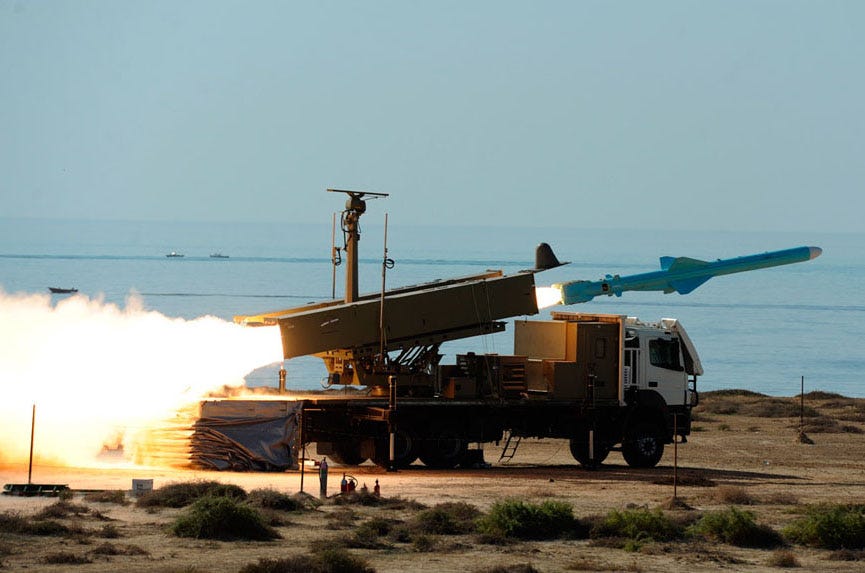
So long as Iran possesses enough anti-ship missiles like this Qader missile occasionally to strike a ship in the Strait of Hormuz, it has the advantage. The Qader has a 300km range. Taking out all these missiles and launchers is easier said than done.
Let’s take this up a level and bring in my beloved André Beaufre and Ferdinand Foch. As I explain in the book I published last week, wars boil down to a contest of wills, with each side seeking to impose its will on the other. Winning or losing is psychological. It is about inducing the other side to think it has no more moves to make. That sometimes means destroying the enemy’s ability to wage war, but the destruction itself is not the point. The point is to convince the other side there is nothing more it can do. To put it in other terms, war ultimately is a struggle to maintain or even expand one’s Liberty of Action while diminishing that of one’s opponent. “Maneuver” amounts to anything one does to increase one’s options. Anything that increases one’s options is good. Anything that diminishes them is bad. Anything that reduces the enemy’s options is good. That is why taking the initiative is crucial: The side with the initiative reduces the options available to the other side by compelling it to respond to its actions, actions which it does at a time and place of its choosing. Because it can.
Back to the Iran war
The U.S. went to war for objectives that were not clear and only defined post hoc. That’s already a huge problem. Eventually, the U.S. articulated a 15-point agenda of things to which it wanted Iran to agree. Iran, meanwhile, had its own 10-point list. These two lists are largely irreconcilable. The only conceivable way Iran would accede to President Trump’s demands was if the United States compelled it to…which means using force up until the point at which Iran concludes there is nothing more it could do. The only way the U.S. might accede to Iran’s demands was if Washington concludes it has no more moves to make. No more Liberty of Action.
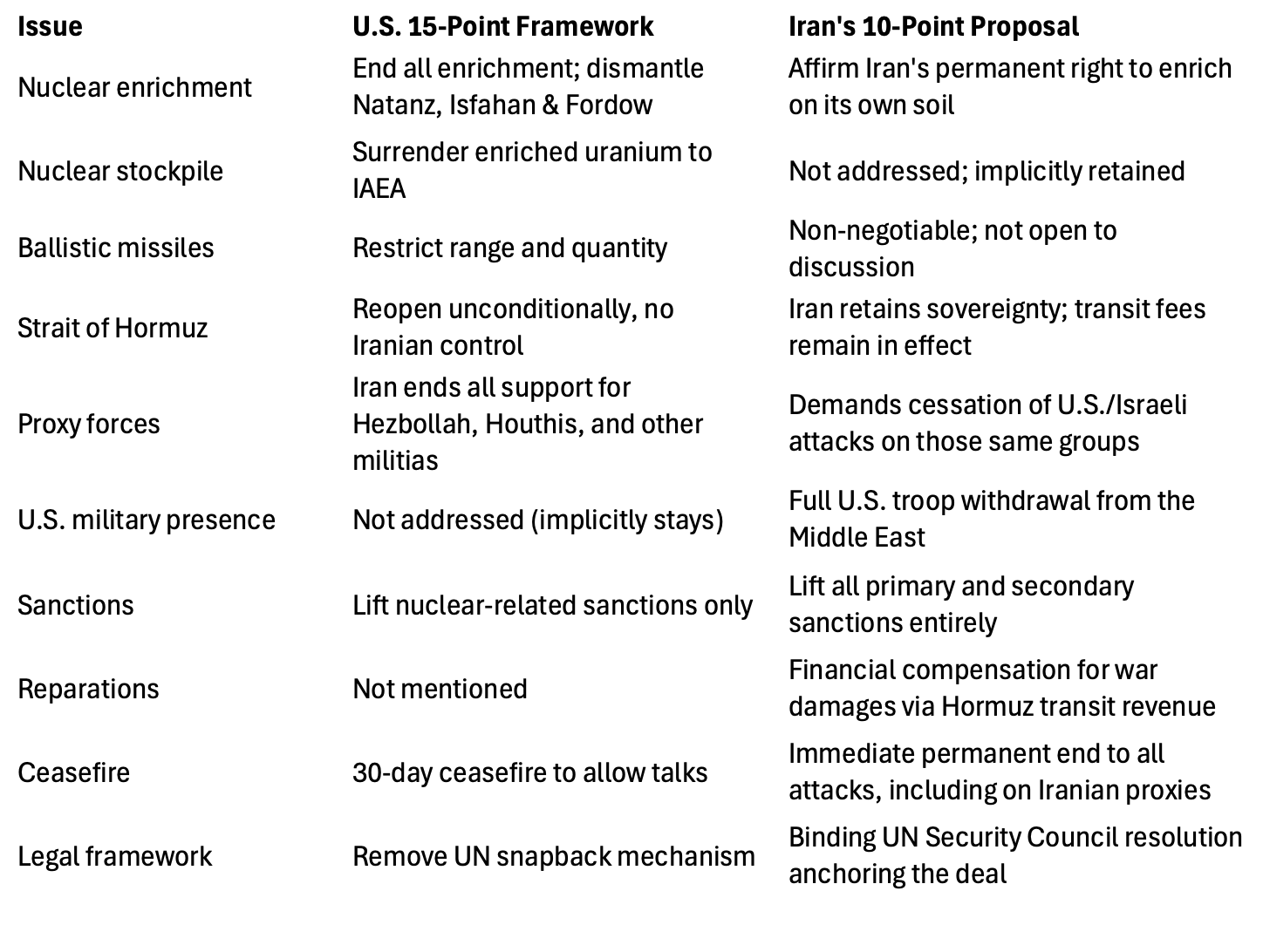
Iran does not believe it has no more moves to make. It can escalate the war further, mainly by doing more damage to its neighbors’ gas and oil industries. It also knows that it holds the single most important card of all, control of the Strait of Hormuz. As for the damage the U.S. and Israel are doing to Iran, there is little evidence the Iranian regime cares. The regime already has proven it is not moved by the loss of life among civilians, and its embrace of martyrdom as a religious ideal may go a long way toward negating the psychological value of having so many high-ranking officials killed. Religion aside, history has shown that bombing people often makes them more resolute. More importantly, Iran knows time is on its side. It has Hormuz, which is the most important thing. But it also benefits from disunion among America’s allies, the lack of resolve among its Gulf neighbors, and dissent within the United States itself. There is simply no way Trump can keep up the fight for long. Thus, there is no reason for Iran’s will to be broken. No reason for Iran to concede the war and sue for peace.
But what about the United States? Has Iran convinced Trump he has no moves left? What remains of America’s Liberty of Action? This is the really bad news: Trump is left with only a few options, none of them good. The basic problem is that so long as Iran holds Hormuz or can hold it at will, the U.S. loses. The only other move Trump could make would be to do something extremely risky to attempt to seize the Strait or oblige Tehran to give it up, perhaps by seizing Kharg. Could the U.S. do that? In theory, yes, but it would require a military effort on a much greater scale than what Trump already has committed to doing, would be costly in lives and treasure, and would benefit from far less domestic and international support. China and Russia would be laughing hysterically. Iran knows war on that scale runs contrary to Trump’s instincts and political interests. Trump’s political support would evaporate. Trump could also seek to escalate the bombing campaign against Iran. But what reason is there to believe that would break Iran’s will?
This is a long way of saying that of the two sides, it is Iran that has the advantage. Those who planned this war—if anyone planned it—forgot the psychological aspect of war, i.e. it is less about material destruction than it is about breaking the enemy’s will. The U.S. and Israel have done a superlative job of killing people and blowing stuff up. But has any of that affected Iran’s will, which is the one thing that matters? Has it created among Iranians the perception that they have no more moves to make, for their Liberty of Action is gone?
The question we all need to be asking now is “what next?” America is weaker and more isolated. It can convince itself it has achieved something by pointing to the long list of Iranian targets the United States Air Force has destroyed. Maybe that is good enough for Israel. But politically speaking, Iran is emerging stronger. It has resisted. It has prevailed. Its regime quite likely has more public than it did before the war. Its ballistic missile stocks are thin, but so what? The U.S. necessarily emerges weaker, and certainly less-trusted. It went rogue and made everything worse. What does that portend for the future?
If you like this content, please consider a paid subscription to support my work. Also check out my recently published book, “The French Way of War,” available internationally on Amazon.
Given that the Israeli Right’s grand strategy seems to have been animated by a military confrontation with Iran, what can we say about this obvious miscalculation and what adjustments they can/should be expected to make?